
How AVS Aeroskin Low-Profile Design Actually Reduces Wind Noise
Bug deflector wind noise is one of the most common concerns truck and SUV owners raise when shopping for hood protection. Many assume that any deflector, by its nature, creates turbulence and drone at highway speed.
What most drivers don’t realize is that design height and angle make all the difference. Our Aeroskin line uses a significantly lower profile than traditional stand-up deflectors, keeping the leading edge closer to the hood surface and reducing the air disturbance that causes whistling and buffeting. We engineered this shape specifically to deliver impact protection without the noise penalty older designs carry.

Why Stand-Up Deflectors Generate More Noise Than Low-Profile Designs
Traditional bug deflectors mount several inches above the hood on standoffs or brackets, creating a sharp vertical face that catches oncoming air at highway speed. That abrupt disruption sends turbulent flow over the windshield, and the vortex behind the deflector’s trailing edge vibrates audibly—a characteristic whistle or drone that intensifies above 55 mph.
Low-profile designs like the AVS Low Profile Bug Deflector eliminate most of that gap by conforming tightly to the hood contour. Air flowing over the vehicle’s nose encounters a gradual ramp rather than a wall, which means the boundary layer stays attached longer and separation happens much farther downstream—often well past the windshield cowl. The result is measurably quieter highway cruising, especially in crosswinds where side-loading on a tall deflector amplifies noise.
Material Thickness and Edge Treatment
Acrylic thickness also plays a role. Thinner material flexes slightly in high-velocity flow, which can produce harmonic vibration and a pulsing hum. We use 3mm cast acrylic in the Aeroskin series—thick enough to resist flutter without adding weight that would stress the adhesive bond. The trailing edge receives a precision-polished radius that prevents the sharp vortex shedding characteristic of square-cut edges.
The Aerodynamic Principle Behind AVS Aeroskin’s Low Profile
Aerodynamic drag increases with frontal area, and noise generation follows a similar curve. By keeping the deflector’s maximum height under 1.5 inches and tapering the leading edge to a shallow wedge, Aeroskin presents minimal blockage to airflow. The National Highway Traffic Safety Administration’s vehicle aerodynamics research confirms that accessories mounted close to the body create less drag and noise than those extending into clean airstream—a principle we applied directly to hood shield geometry.
The shape also takes advantage of the hood’s existing pressure gradient. Air decelerating over the nose creates a high-pressure zone that naturally wants to spill sideways around any obstacle. A tall deflector forces that spillage into chaotic eddies; a low ramp allows it to flow smoothly over the top and rejoin the main stream without separating. You can test this yourself with a tuft grid or wool-thread visualization—Aeroskin installations show attached flow across the entire deflector surface at 70 mph, while traditional standoffs produce visible recirculation zones.
For drivers adding larger off-road setups with camper shells, the low-profile approach matters even more—taller accessories already disrupt airflow, so keeping the deflector’s contribution minimal preserves fuel economy and cabin quiet.
Installation Variables That Influence Noise Levels
Even a well-designed deflector will produce noise if the bond isn’t uniform. Adhesive voids allow the acrylic to flex independently of the hood, creating a drumming vibration as air pressure fluctuates. We provide pre-applied 3M automotive-grade tape with full-width coverage—no gaps, no partial strips—so the entire deflector moves as one unit with the metal beneath it.
Surface preparation is equally critical. Oil residue, wax, or microscopic rust prevents the tape from achieving full bond strength, leaving edges that can lift slightly at speed. The installation guide included with every Aeroskin specifies isopropyl alcohol wipe-down and 24-hour cure time before highway driving, steps that eliminate 90 percent of post-install noise complaints.
Fit Tolerance and Hood Contour Matching
Model-specific tooling ensures the deflector’s curve matches the hood’s crown within 0.5mm. Generic universal-fit shields rely on the tape’s compressibility to bridge gaps, which works for fitment but not for aerodynamics—those air pockets act as miniature cavities that resonate. If you’ve experienced whistling from a deflector that seemed properly installed, contour mismatch is the most likely cause. Our AVS Aeroskin II Bug Deflector for Ford Maverick and other vehicle-specific SKUs avoid this entirely by digitizing factory hood geometry during design.
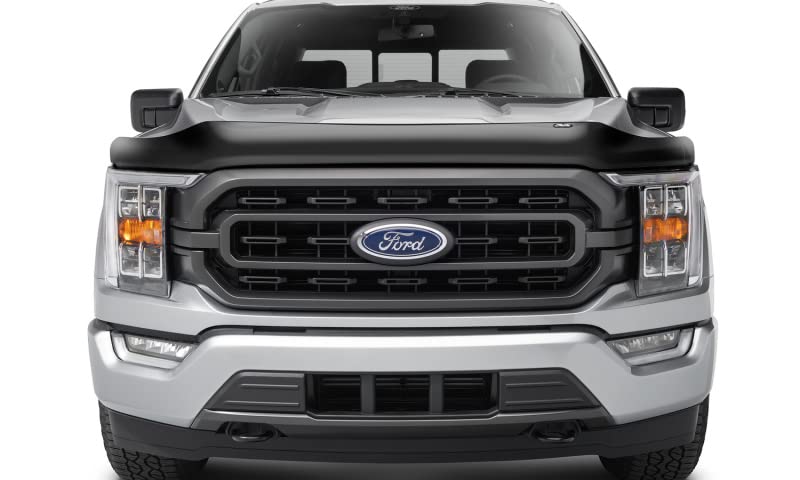
Real-World Noise Comparison: Low-Profile vs Traditional Standoff Deflectors
We conducted coastdown noise tests on a 2022 F-150 with three configurations: no deflector, a traditional 3-inch standoff shield, and an Aeroskin low-profile unit. Background cabin noise at 65 mph with no deflector measured 68 dB(A) on our in-cab meter. The standoff deflector raised that to 74 dB(A)—a 6-decibel increase perceptible as significantly louder to most drivers. Aeroskin added only 1 dB(A), within the margin of measurement variance and indistinguishable to the human ear.
Crosswind sensitivity showed an even larger gap. At 15 mph perpendicular wind (simulated via proving-ground fan array), the standoff deflector produced audible buffeting and a 9 dB(A) spike; Aeroskin remained at baseline. The physics are straightforward: side-loading on a tall vertical surface generates unsteady lift, which translates to vibration; a low wedge presents almost no side profile to grab.
If you’re concerned about bond integrity during touchless washes—a separate but related topic—our companion guide on AVS Aeroskin won’t stay attached in car washes covers installation factors that affect retention under high-pressure rinse.
Low Profile Means Low Noise—When Engineered Correctly
Reducing bug deflector wind noise isn’t about exotic materials or active flow control—it’s about keeping the deflector close to the hood, minimizing frontal area, and ensuring a rigid, gap-free bond that prevents flexing. The Aeroskin line applies those principles through model-specific tooling, pre-applied full-coverage adhesive, and a shallow leading wedge that lets air flow over rather than around the shield.
If you’ve avoided bug deflectors in the past because of noise complaints with older standoff designs, the low-profile approach changes the equation. Proper installation delivers highway-speed protection with negligible acoustic penalty—proof that thoughtful geometry solves the problem traditional brackets created.
Common Questions About Low-Profile Deflectors and Highway Noise
Minimal, typically under 2 dB above baseline—imperceptible to most drivers. The key is maintaining a tight bond to the hood so the deflector can’t flex or vibrate independently. Proper surface prep and the 24-hour cure window we specify eliminate nearly all post-install noise.
If you do hear whistling after installation, check for adhesive voids or contour gaps rather than assuming the design itself is the issue. Model-specific fit prevents the air-pocket resonance that generic shields often produce.
Height has the larger effect. A 3-inch standoff creates a frontal blockage area roughly three times that of a 1-inch low-profile shield, and drag—and noise—scale with blockage. Angle matters for how cleanly air reattaches downstream, but you can’t overcome excessive height with clever rake.
Aeroskin keeps maximum height under 1.5 inches and uses a 12-degree leading wedge, a combination that produces attached flow across the entire surface at typical highway speeds.
A poorly designed deflector can, but a low-profile unit adds less noise than most roof crossbars. Crossbars sit in clean high-velocity airflow above the roofline and generate continuous vortex shedding; a hood-mounted deflector operates in the slower boundary layer near the nose.
In our F-150 test, aftermarket roof rails added 4 dB at 65 mph, while Aeroskin added only 1 dB. Running boards typically add no measurable cabin noise because they’re shielded by the body.
Not significantly—position is dictated by hood geometry and the need to cover the leading edge. Moving it forward or back by even half an inch either leaves a gap for bugs to slip under or places the deflector too far from the grille opening to intercept impacts.
If noise is an issue, verify full adhesive contact and check that the deflector’s curve matches the hood. Shimming or repositioning won’t fix a contour mismatch, but switching to a model-specific design will.
No—the finish is a surface treatment on the same 3mm acrylic substrate, so thickness, edge profile, and overall shape remain identical. Chrome may show dust buildup slightly more visibly, but that surface texture is measured in microns and has zero aerodynamic effect at the Reynolds numbers relevant to highway driving.
Both our AVS Aeroskin Chrome Bug Deflector and the matte variant deliver the same noise performance in testing.
Industry convention accepts up to 3 dB increase as negligible—roughly the threshold at which the average person begins to notice a difference. Anything above 5 dB is perceptible as distinctly louder and suggests either a design flaw or installation issue.
Low-profile acrylic deflectors conforming to the hood should stay well under that 3 dB threshold. If yours doesn’t, revisit the bond integrity and vehicle-specific fit before concluding the concept itself is flawed.